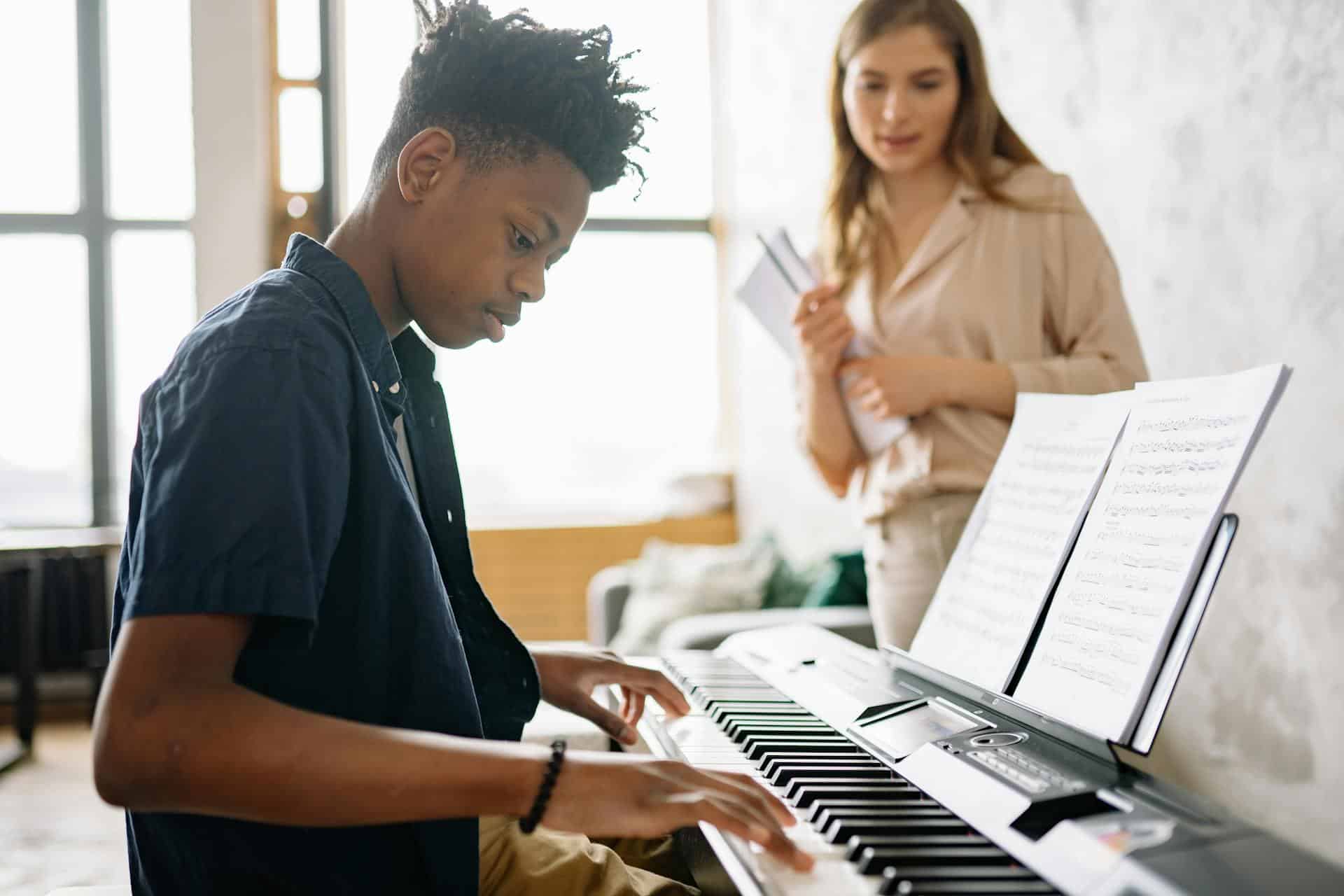
Maybe your 12-year-old just heard a friend play and came home asking for lessons. Maybe your 14-year-old has been teaching themselves songs from videos. Either way, a lot of parents wonder the same thing: is it too late to start piano?
It isn’t. Here’s what the research says about starting later, the real advantages older beginners have, the challenges to plan for, and how to set a tween or teen up to stick with it.
The short answer
No, 10, 12, 14 and even 16 are not too late to start piano. Older beginners can learn to play well, often move through the beginning stages faster than young children, and get many of the same benefits. What changes with age is the approach, not the possibility.
What research says about starting early
You may have read that kids who start music before age 7 have an advantage. There’s real research behind that, but it’s narrower than it sounds.
In a 2013 study in the Journal of Neuroscience, researchers at Concordia University and McGill compared 36 adult musicians. Half started before age 7 and half started later, and the two groups were matched for years of training. The early starters had stronger connections in one part of the brain and did slightly better on a timing task. Senior researcher Virginia Penhune was careful about what that means. She noted that these differences “don’t necessarily make them better musicians,” because performing also depends on things like communication, enthusiasm and style. Her summary: “while starting early may help you express your genius, it probably won’t make you a genius.”
In other words, starting early has some measurable effects on the brain. It doesn’t decide whether your child can learn to play well and enjoy it.
Teen brains still respond to music training
Starting in the teen years has real benefits too. A study published in the Proceedings of the National Academy of Sciences in 2015 followed 40 Chicago high school students from freshman to senior year. Students in band class, two to three hours a week, showed faster development in how the brain responds to sound, and bigger gains in language-related skills, than classmates in a fitness-focused program. It was a small study, and the students chose their own activities, but the researchers’ conclusion was clear: the adolescent brain still responds to music training. (For more on what the research does and doesn’t show, see does learning piano make kids smarter?)
Advantages older beginners have
- They read well already. A 12-year-old who reads fluently and knows fractions picks up note names and rhythm counting faster than a 6-year-old still learning to read words.
- Longer attention spans. Older kids can stay focused through a full lesson and 20 to 30 minutes of practice a day, so each week covers more ground.
- Better coordination and bigger hands. Fine motor control is more developed, and bigger hands can reach wider intervals sooner.
- They understand the “why.” Older students grasp concepts like chords, scales and how songs are built quickly, which speeds up everything else.
- They choose it. A teen who asked for lessons is usually more motivated than a younger child who was signed up. That motivation is one of the strongest predictors of progress we see.
The challenges to plan for
- Busy schedules. School, sports, jobs and friends compete for time. A realistic practice plan matters more than an ambitious one.
- Feeling like a beginner. Teens can feel self-conscious about playing simple pieces. Private lessons help, since there’s no audience.
- “Baby songs.” Most beginner books are written for young children. Older beginners need material that sounds like music they actually listen to.
- The taste gap. Teens know what great playing sounds like, so the gap between what they want to play and what they can play yet can be frustrating. Quick early wins make a big difference.
How to set an older beginner up to succeed
- Start with music they love. Pop songs, movie and video game soundtracks, worship songs: whatever they listen to. A simplified version of a favorite song is more motivating than any exercise.
- Learn chords early. Chords let older beginners play along with real songs within weeks, which closes the taste gap fast. Reading music still matters, and the two skills grow together. Here’s how they fit in playing by ear vs. reading music.
- Set a goal they care about. Playing a specific song by summer, accompanying a friend who sings, or writing their own song. Composing is one of the four pillars of the Volz Method, and teens often love it.
- Make a practice plan that fits their week. About 20 to 30 minutes most days is a good target for ages 10 to 12, and teens can do more if their goals call for it. Attach practice to something that already happens, like right after homework. See our practice guide by age. A 30-minute weekly lesson is still the right starting point for most older beginners; here’s how long piano lessons should be by age.
- Find a teacher who fits. An older beginner needs a teacher who treats them like the young adult they are and doesn’t hand them materials meant for a 6-year-old. Personality matters more than you might think; here’s why the teacher’s personality is the most important variable.
What progress looks like
Every student is different, but with weekly lessons and regular practice, most older beginners:
- Play a simple, recognizable song within the first few weeks
- Play simplified versions of songs they love within the first several months
- Play songs people know comfortably within one to two years
Consistency matters more than age. For more detail, see how long it takes to learn piano.
What about becoming a concert pianist?
Most professional concert pianists did start young. But that’s a goal very few early starters reach either. For nearly every family, the real goals are different: playing songs they love, playing for friends and family, accompanying at school or church, writing music, and having an instrument for life. All of those are within reach for a student who starts at 10, 12 or 14.
Common questions
Is 14 too old to start piano?
No. A 14-year-old can learn to play well, and often progresses quickly through the early stages thanks to stronger reading, coordination and focus. The key is music they enjoy and a practice routine that fits their schedule.
How long should a 13-year-old practice piano?
About 20 to 30 minutes most days is a good starting point for a beginner this age, with more as their goals grow. Focused practice on the hard spots beats long, unfocused sessions. More on that in the 80/20 rule for piano.
Is 12 too late to start piano? Can a 12-year-old learn fast?
No, 12 is not too late. And yes, 12-year-olds often learn quickly. Older beginners usually move through beginning material faster than young children because they already read well and can focus longer. “Fast” still means months and years, not weeks, but early progress is often quick and encouraging.
Is it too late to start piano at 16 or 18?
No. The same advantages apply, even more so: older teens read well, focus for longer and know exactly what music they want to play. Plenty of people start in their late teens or as adults and go on to play for a lifetime. What matters is a clear goal and a routine that fits their schedule.
Should I let my 12-year-old quit piano?
Before deciding, find out why they want to stop. Often it’s the music, the practice routine, or the teacher fit, and those can change. Here’s what to do when your child wants to quit.
Is piano or guitar better for an older beginner?
Both work well. Piano makes music theory easy to see and is a great foundation for any instrument. Here’s a side-by-side comparison of piano vs. guitar for kids.
Lessons built around your child
Volz Method teachers come to your home and build lessons around how your child learns and the music they want to play. For older beginners, that means real songs early, room to write their own music, and a practice plan that fits a busy schedule. Book a free 15-minute call to talk about your child and see if lessons are a good fit.