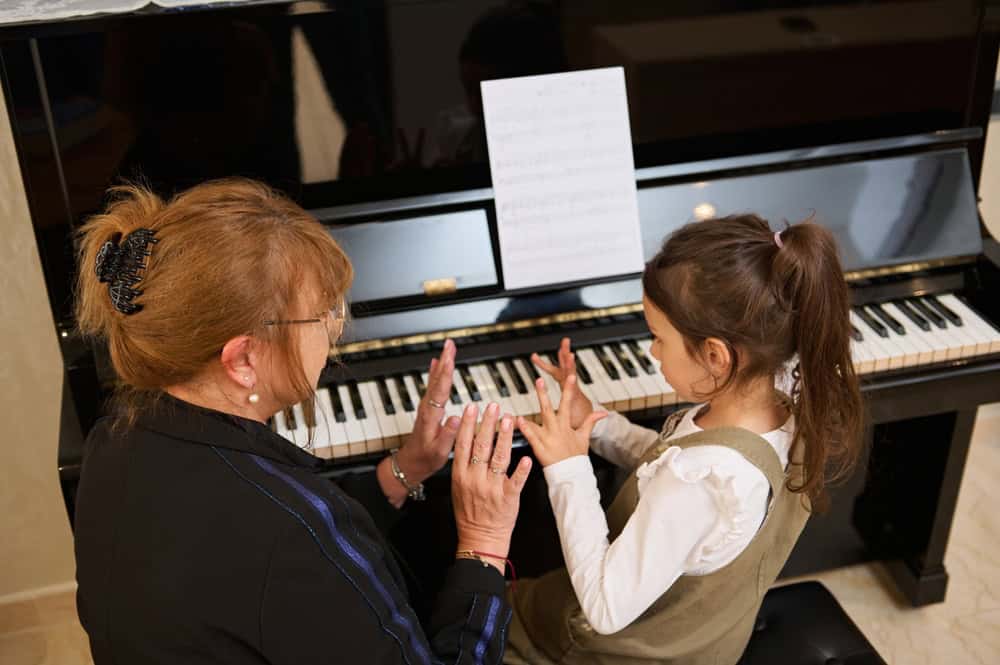
When you sign your child up for piano, one of the first choices is lesson length: 30 minutes, 45 minutes or a full hour. Longer can feel like better value, but for most kids it isn’t. The right length depends on your child’s age, attention span and how far along they are.
Here’s a practical guide by age, why 30 minutes works so well for children, what a good half-hour lesson includes, and the signs your child is ready for more.
The short answer
For most children, especially beginners between about 5 and 10, a 30-minute lesson once a week is the right length. Longer lessons start to make sense as kids get older and more advanced, when their pieces are longer and they’re practicing more at home. For many teens and advanced students, 45 to 60 minutes fits better.
A guide by age
- Ages 3–5: 30 minutes, broken into short, playful activities. Preschoolers learn in quick bursts, so the lesson moves between games, songs and time at the keys. See piano lessons for preschoolers.
- Ages 5–9: 30 minutes. This is the sweet spot for starting lessons, and a focused half hour matches what young beginners can absorb.
- Ages 10–12: 30 minutes for most. Some advanced, focused students do well with 45, especially if they’re practicing 20–30 minutes a day.
- Teens and advanced students: 30 to 60 minutes, depending on goals. Longer repertoire, auditions and deeper theory work all need more time.
Treat these as starting points. A child’s focus and progress matter more than their birthday, the same way readiness matters more than age when deciding when to start.
Why 30 minutes works so well for kids
- It matches attention spans. A focused, engaging 30-minute lesson beats an hour that loses your child halfway through. The last 20 minutes of a long lesson often teach very little.
- The real progress happens at home. A lesson’s job is to fix problems, teach the next step and set up the week’s practice. The skill itself gets built in short daily practice between lessons.
- Short and frequent beats long and rare. Learning research consistently finds that spreading practice out works better than cramming it into one session. A large review of hundreds of experiments (Cepeda and colleagues, Psychological Bulletin, 2006) found spaced practice beats massed practice for memory. A weekly lesson plus a few minutes most days follows that pattern.
- Quick wins keep kids motivated. Kids who leave a lesson having nailed something new want to come back. Short lessons make that more likely.
- It fits the week. A half hour slots in after school without crowding out homework, sports and dinner.
What a good 30-minute lesson includes
A great half-hour lesson moves at a steady pace and never feels rushed. A typical flow for a young student:
- Check in on last week (about 5 minutes). Your child plays what they practiced; the teacher listens for what improved and what still needs work.
- Fix and learn (10–12 minutes). The teacher works on the trickiest spots and introduces the next piece or skill.
- Build musicianship (about 5 minutes). A rhythm game, reading practice, ear training or a little theory.
- Something creative (about 5 minutes). Making up a melody, playing a song by ear or rearranging a favorite.
- Set up the week (2–3 minutes). A specific practice plan: what to play, which spots to work on and how.
In the Volz Method, those middle steps rotate through four pillars (reading, composing, hearing and arranging), leaning into the ones your child takes to. Read more in inside the four pillars of the Volz Method.
Are 30-minute piano lessons worth it?
For most kids, yes. Thirty minutes is enough time to correct technique, learn new material and set clear goals, as long as the lesson is focused and your child practices between lessons. A longer lesson can’t make up for a week without practice; a shorter one with good practice will move faster.
Thirty minutes is also the most affordable way to get one-on-one teaching. Volz Method lessons are $29–$52 per half hour, depending on your city and how many students are in your home. See how lessons and pricing work.
Signs your child is ready for a longer lesson
- They finish everything the teacher planned with time to spare, week after week
- Their pieces have gotten long enough that there isn’t time to hear them and also learn something new
- They’re practicing 30 minutes or more most days, by choice
- They have a goal that needs extra time, like an audition or recital piece
- They’re a teen who can stay focused for 45 minutes or more
If you’re seeing several of these, talk with your child’s teacher about whether more time would help.
How to get the most out of a 30-minute lesson
- Be ready on time. Piano cleared off, music out, child fed and not mid-meltdown. Every minute counts.
- Keep the same weekly slot. A predictable time makes lessons and practice part of the routine.
- Check in for the last few minutes. Ask what to practice this week. Here’s more on whether to sit in on lessons.
- Practice smart, not long. A few focused minutes on the hard spots does more than a long run-through. That’s the 80/20 rule for piano.
With in-home lessons, all 30 minutes go to learning: no drive there and back, no waiting room, and your child plays on the same piano they practice on all week. Volz Method teachers come to homes across Salt Lake, Utah and Davis counties. See where our teachers drive.
Common questions
Is 30 minutes enough for piano lessons?
For most children, yes, especially beginners and kids under about 12. Progress depends more on regular practice between lessons than on lesson length.
How much is a 30-minute piano lesson?
Prices vary by teacher and area. Volz Method in-home lessons are $29–$52 per half hour, depending on your city and how many students are in your home, with multi-student discounts. Here’s our guide to piano lesson prices in Utah.
How long does it take a child to learn piano?
Most kids play a simple, recognizable song within the first few weeks, and comfortably play songs people know within one to two years of steady lessons and practice. See a realistic timeline for kids.
Should young kids have lessons twice a week?
Usually not. One focused lesson a week plus short daily practice gives most children plenty to work on. More lessons can’t replace practice at home.
Start with a free call
Not sure what’s right for your child? Book a free 15-minute call. We’ll talk about your child’s age and experience, give you an exact price for your area and, if you’re ready, match your child with a teacher who comes to your home.