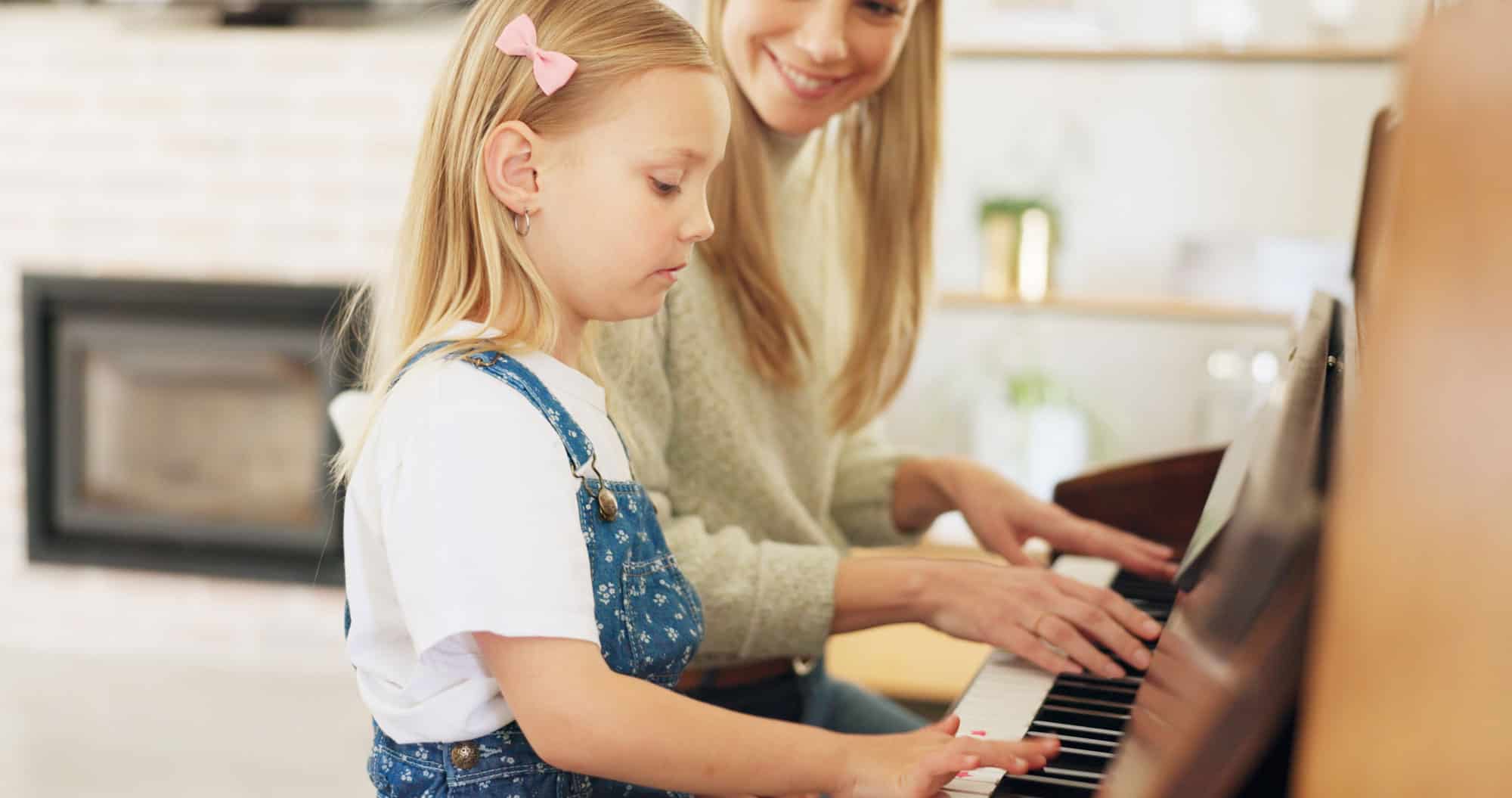
If you’ve started looking for a piano teacher, you’ve probably heard of the Suzuki method. It has a devoted following and a very different approach from the method books most teachers use. Here’s how the two compare, the honest pros and cons of each, and how to tell which one fits your child.
What the Suzuki method is
Japanese violinist Shinichi Suzuki built his method on how children learn their first language. The Suzuki Association of the Americas puts it simply: “We teach students by ear first,” and “We do not ask them to read before they can speak.” Dr. Suzuki called this the mother-tongue approach.
In practice that means:
- An early start. Formal training “may begin at age three or four.”
- Daily listening. Children listen to recordings of the pieces they’ll learn every day.
- A parent as home teacher. Parents attend lessons, take notes and guide practice at home.
- Review. Earlier pieces stay in a student’s repertoire and get played again and again.
- Group classes. Students “should expect to take part in group lessons and performances.”
- Reading later. Children learn to read music after they can already play.
Suzuki teachers take registered training. The first unit alone runs at least 8 days, with 28 hours of class and 15 hours of observing lessons.
What’s in Suzuki piano Book 1
Every Suzuki piano student learns the same pieces in the same order. Book 1 opens with the Twinkle Twinkle Little Star Variations and continues with:
- Lightly Row, The Honeybee, Cuckoo, French Children’s Song, London Bridge
- Mary Had a Little Lamb, Go Tell Aunt Rhody, Au Clair de la Lune, Long Long Ago
- Little Playmates, Chant Arabe, Allegretto 1 (Czerny), Goodbye to Winter, Allegretto 2 (Czerny)
- Christmas-Day Secrets, Allegro (Suzuki) and Musette
If you’ve heard of “the Bach Minuets,” those are in Suzuki violin Book 1. Piano students meet Bach in later books.
What “traditional” lessons look like
Most teachers use a method book series such as Faber’s Piano Adventures or Alfred’s courses. These teach reading from the start. Faber’s Primer level, written for ages 6 to 11, begins with “pre-reading” off the staff: notes going up, down or repeating. Then it introduces three “guide notes” (Middle C, treble G and bass F) and has students read the notes around them by steps and skips. For ages 5 to 6, Faber publishes My First Piano Adventure. More on how reading is taught in how kids learn to read piano notes.
Side by side
| Suzuki | Traditional method books | Volz Method | |
|---|---|---|---|
| Typical starting age | 3 to 4 | About 5 to 7 | Most kids are ready at 5 to 9; preschool lessons from age 3 |
| How music is learned first | By ear, from recordings | By reading | Reading, composing, hearing and arranging, balanced for each child |
| When reading starts | After playing is established | From the first book | Taught to every student, at a pace that fits the child |
| Parent’s role | Attends every lesson; daily home teacher | Supports practice | Supports practice at home; welcome to sit in |
| Group classes | Expected | Varies by teacher | Lessons are one-on-one, at home |
| Music | Fixed Suzuki sequence | Method book series | Tailored to each child, including songs they already love |
| Teacher training | Suzuki Association units | Varies | Three months in the Volz Method |
The strengths and criticisms of Suzuki
Suzuki students often develop a strong ear, good tone and real confidence performing, and the early start and involved parents help many families. The criticisms are real too. Timothy McKenry, a music professor writing in The Conversation, notes critics’ concerns about “a lack of engagement with music notation and improvisation” and “an over-reliance on rote learning.” He also points to the “challenges associated with Suzuki’s requirement for high levels of parental involvement,” especially for single-parent and lower-income families.
No controlled study has settled the debate. Both approaches produce good pianists. The better question is which one fits your child and your family.
Which fits your child?
Suzuki may be a good fit if:
- Your child is 3 to 5 and loves to listen and copy
- A parent can attend every lesson and guide practice every day
- You value group classes and classical repertoire
Traditional lessons may fit if:
- Your child already reads well and likes structure
- You want reading from day one
A flexible approach may fit if:
- Your child is most motivated by music they already love
- They learn some things by ear and others by reading
- Your family’s schedule makes attending every lesson hard
That flexible middle is where the Volz Method sits. Teachers balance four pillars (reading, composing, hearing and arranging) around how each child learns, and every student learns to read. Read what the Volz Method is or see inside the four pillars.
Common questions
Is the Suzuki piano method good?
Yes, for many children, especially young ones with a parent who can be closely involved. Critics point to delayed reading and a heavy parent commitment. It depends on your child and your family.
When do Suzuki students learn to read music?
After they can play by ear. The timing varies by teacher, but reading comes later than in method-book lessons.
Do Suzuki parents have to attend lessons?
Typically yes. The parent attends, takes notes and acts as the home teacher. Many programs also require group classes.
Can a child switch from Suzuki to traditional lessons?
Yes. A new teacher will check reading skills and may spend extra time there. A Suzuki student’s strong ear carries over.
What age is best to start?
Suzuki starts as young as 3. Most children are ready for other lessons between 5 and 9. See the best age to start piano and our preschool piano lessons.
Find the right fit
Volz Method teachers come to your home across Salt Lake County, Utah County and Davis County. Book a free 15-minute call and tell us how your child learns. We’ll help you decide whether our approach is the right match.