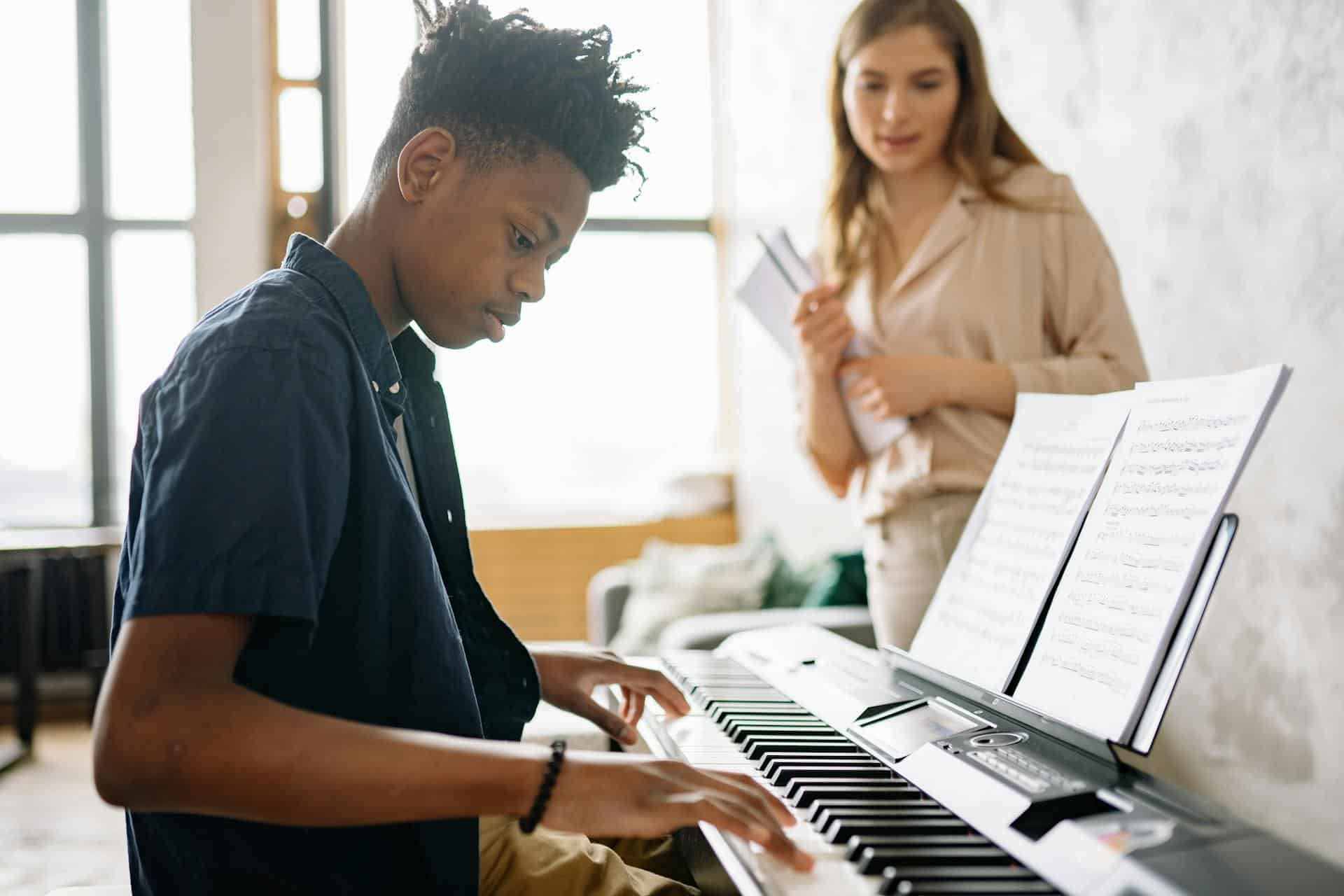
Almost every beginner hits the same wall. The right hand knows its part, the left hand knows its part, and together they fall apart. It’s normal, and there’s a reliable way through it.
Why hands together is hard
Playing with both hands means each hand does a different job at the same time, often with different rhythms. That coordination is still developing through childhood. In one study of 92 people aged 9 to 23, coordination on an alternating-hands task improved steadily with age, and the 9- to 11-year-olds were slowest. Better coordination went along with maturity in the connection between the brain’s two halves. If your child feels clumsy, their brain is doing exactly what it should.
A step-by-step way to get there
- Learn each hand alone, but briefly. Interlochen Center for the Arts advises getting “comfortable with the notes and rhythms of each individual hand before attempting to play them together.” Move on to hands together as soon as each hand is secure.
- Tap it first. Tap the right-hand rhythm on one knee and the left-hand rhythm on the other. Getting the rhythm right without the notes makes the next step easier.
- Read up and down. Before playing, look at which notes line up. As Piano For Dummies puts it, read the music “vertically (bottom to top) before moving on horizontally.”
- Shrink the chunk. Work on one measure plus the first note of the next. Interlochen suggests you “extract portions of the music.”
- Go slow. Interlochen’s advice: “Play the piece slowly at first, not moving to a faster tempo until you can play it perfectly.” Slow enough means no mistakes.
- Find the exact trouble spot. Mark it in pencil, slow down just before it, and repeat that spot alone.
- Then stop. End while it’s going well, and come back tomorrow.
What research on practice says
In a 2009 study of 17 college piano majors, how long and how often they practiced didn’t predict how well they played. How they practiced did. The best performers played hands together early, found exactly where and why each mistake happened, fixed it, and varied their tempo on purpose. These were college pianists, but the habits work at any age.
Sleep matters too. In a 2002 study in Neuron, people who learned a finger-tapping sequence got about 20% faster after a night’s sleep, with no loss of accuracy. The same amount of time awake gave no real benefit. So short daily practice beats one long weekend session. That’s the idea behind the 80/20 rule for practice and our practice guide by age.
Hands-together exercises for beginners
Your child’s teacher will choose what fits, but these are common starting points, roughly from easiest to hardest:
- Parallel motion. Both hands play C-D-E-D-C at the same time, an octave apart.
- Contrary motion. Thumbs share Middle C and both hands move outward, then back.
- Melody plus one held note. The right hand plays a simple tune; the left holds one note per measure.
- Melody plus a chord on beat one. The left hand plays a simple chord at the start of each measure.
- Two different rhythms. The right hand plays quarter notes over a left hand playing half notes.
Once these feel easy, the fun, easy songs kids actually want to learn make great hands-together practice.
How parents can help
- Don’t push speed. Slow and correct is progress.
- Ask to hear one measure, not the whole song.
- Celebrate the first time it works, even at a crawl. That’s the breakthrough.
- Keep sessions short. Ten focused minutes beats thirty frustrated ones.
If the left hand lags, check the bass clef too. Many kids read it more slowly. See how kids learn to read piano notes.
When to check in with the teacher
- Your child has been stuck on the same spot for two to three weeks
- Their hands, wrists or shoulders look tense or hurt
- They’ve started avoiding the piano
Any of those means the step is too big, not that your child can’t do it. A teacher can break it down further. If frustration is turning into wanting to quit, here’s what to do.
Common questions
How long does it take to play piano with both hands?
It varies. Simple hands-together pieces usually come early in a beginner’s lessons, but smooth coordination with different rhythms in each hand takes months and keeps improving for years.
Should you learn piano hands separately first?
Yes, briefly. Learn each hand until it’s secure, then put them together slowly. Staying hands-separate too long can make the combination harder.
Why is my child’s left hand so much weaker?
Most kids use it less and read the bass clef less fluently. Extra slow repetitions for the left hand alone usually close the gap.
Is it normal for kids to struggle with hands together?
Completely. Coordination between the hands keeps developing through the teen years.
What are good hands-together exercises for beginners?
Parallel and contrary motion, then a melody over a held note or simple chord, are the usual first steps.
Help that comes to you
Volz Method teachers work with your child at your own piano, so they can see exactly where hands-together playing breaks down and fix it right there. We teach across Salt Lake County, Utah County and Davis County. Book a free 15-minute call to get started.