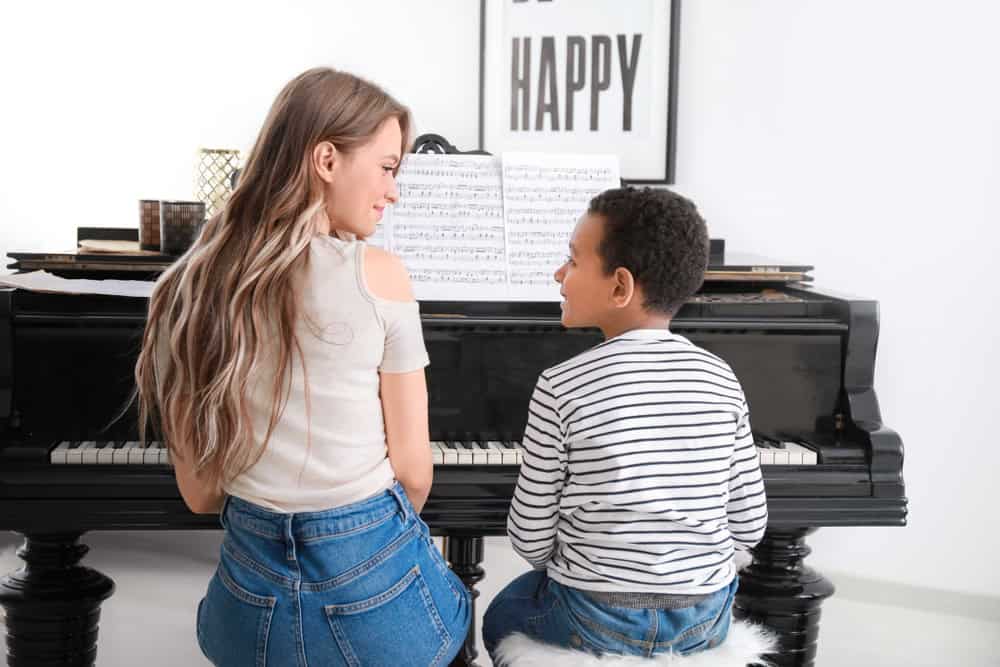
One of the quiet perks of in-home piano lessons is that you’re right there. One of the quiet dilemmas is working out what you’re supposed to do while the lesson is happening. Pull up a chair by the piano? Fold laundry within earshot? Leave them to it entirely?
There’s no single right answer, but there is a pattern that works for most families — and a few habits that quietly get in the way. Here’s how to think about it.
The short answer
Be close by, not front and center. For most children, the sweet spot is being present at the start and the end of the lesson, and out of the spotlight in the middle. Exactly how close you should be depends on your child’s age, temperament, and how long they’ve been playing.
When sitting in really helps
The first few lessons. Early on, your presence helps everyone settle. Your child feels safe with someone new, the teacher learns a little about your family, and you see what a lesson actually looks like. If you’re curious what to expect, here’s what happens in a first piano lesson.
Very young beginners. Five- and six-year-olds often benefit from a familiar face nearby — and you’ll pick up what good practice looks like, which makes helping at home much easier.
When something has changed. A new teacher, a big jump in difficulty, or a stretch where your child seems frustrated are all good moments to watch a lesson or two and see what’s going on.
When practice at home has fallen apart. Watching how the teacher breaks a tricky passage into small pieces is the single best guide to how you can support practice during the week.
When hovering backfires
The trouble with a parent sitting in on every lesson is rarely the parent — it’s what an audience does to a learner.
- They perform instead of learn. Kids with a parent watching often glance over after every phrase, checking your face instead of listening to their teacher.
- Mistakes start to feel public. Learning an instrument means playing a lot of wrong notes. An audience makes children play it safe, and playing it safe is how progress stalls.
- Two teachers in one room. A well-meant “you missed the F-sharp” from the couch competes with the teacher’s plan and can quietly undercut it.
- The relationship needs room. The bond between a child and their teacher forms one-on-one, and that bond matters more than almost anything else — it’s why we believe the teacher’s personality is the most important variable.
A rough guide by age
- Ages 4–6: Stay in the room or within sight for the first several lessons, quietly in the background. As your child gets comfortable, gradually move further away.
- Ages 7–10: Say hello, step out, and come back for the last few minutes.
- Ages 11 and up: Give them space. Ask them to play you what they learned once the teacher has gone.
Treat these as starting points rather than rules. Your child’s temperament matters more than their birthday — the same way readiness matters more than age when deciding when to start.
The best of both: the five-minute check-in
Here’s the habit we’d recommend to almost every family: instead of watching the whole lesson, join for the last five minutes. Ask the teacher two things — what did you work on today, and what should practice look like this week?
Volz Method teachers leave a simple practice plan each week, and the check-in is where you learn how to use it. You get everything you need to support your child without ever becoming a distraction. Not sure how much practice is right? Here’s a realistic practice guide by age.
What to do instead of watching
This is where in-home lessons shine. There’s no waiting room to sit in, so you can start dinner, help a sibling with homework, or answer a few emails while the lesson happens down the hall. Many kids actually like knowing you can hear them — it’s support without the spotlight. It’s one of the quieter benefits of lessons at home.
After the lesson is where you matter most
Your biggest influence isn’t during the half hour the teacher is there — it’s the rest of the week. Ask your child to play you the new thing. Be an enthusiastic audience. Praise effort and persistence rather than perfect notes. And resist the urge to critique; that’s the teacher’s job, and your job is encouragement. We go deeper in the two things that solve most practice problems.
Signs to step back — and signs to lean in
Step back if your child keeps looking over at you, stiffens when you walk in, plays noticeably worse while you watch, or tells you, “You don’t have to stay.” (Take that last one as a compliment — it means they’re comfortable.)
Lean in if your child is anxious or very young, practice at home keeps collapsing because nobody is sure what they’re meant to be doing, or they’ve hit a rough patch. If it’s turned into “I want to quit,” here’s what to try before you cancel.
Common questions
Should I be home during in-home lessons? It’s a good idea to have an adult at home, especially with younger children — but being home and being in the room are two very different things.
Can I record the lesson? Ask the teacher first. A short clip of a finished song for the grandparents is lovely; a phone pointed at your child every week adds pressure they don’t need.
My child wants me there every time. Is that a problem? Not at first. Comfort comes before independence. Move gradually — from beside the bench, to across the room, to the next room — at whatever pace your child is happy with.
Can I ask the teacher questions during the lesson? Save them for the five-minute check-in at the end. A half-hour lesson goes quickly, and every minute belongs to your child.
Lessons that come to you
Volz Method lessons are one-on-one in your own home across Utah, with the same dedicated teacher every week, $29–$52 per half hour, on a simple month-to-month agreement with no long-term contract. Book a free 15-minute call and we’ll answer anything you’d like to know — including how involved you’d like to be.